Rare Evidence of Jesus' Death and Resurrection Outside the Bible: Historical, Archaeological, and Contemporary Proof
Jesus of Nazareth is the number one figure in Christianity and a top moral figure in global influence. The teaching of Jesus on the subject of love, compassion, service, and forgiveness surpasses, and is unique to, any moral law that ever existed, forming the foundation of modern day ethics, especially, in the Western world and Judeo-Christian hemisphere.
Jesus is considered the only morally perfect man that ever walked the earth by many, and fully recognized as such by many religious groups including Christians, Muslims, and others. While there is debate by some religious groups about his divinity, Jesus himself said that He was the only begotten Son of God which also mean being God incarnate, and billions around the globe and throughout history believed in Him. This claim makes John 3:16 the most beloved and popular Bible verse in the world having being translated into over 1100 languages. The verse is a direct statement from Jesus Christ about Himself which says,
"For God so loved the world, that he gave his only begotten Son, that whosoever believeth in him should not perish, but have everlasting life."
John 3:16 expresses God's love for mankind and why Jesus Christ came, including the purpose of His coming which include to die on the cross and shed His blood for the atonement of sin.
The Chronological Record of Jesus Death and Resurrection
Jesus was crucified by 9:00am on 3rd April, 33AD, following a sleepless night of false accusations, legal trials, mockery, and torture. He died by exactly 3.00pm of same day after 6 hours of suffering on the cross. Thousands of people, including Roman officials, Jewish leaders, and ordinary people, witnessed his last moment on the cross. His last words were, "It is finished".
At the time of His dead, Pontius Pilate (who authorized Jesus execution) was the governor of Judea, High Priest Caiaphas headed the Jewish Sanhedrin in Jerusalem, Herod Antipas was tetrarch of Galilee, and Emperor Tiberius was the Roman Emperor.
Jesus resurrected 3 days after His death and burial, walked among his disciples and many other people for 40 days before he ascended alive to heaven, promising His followers that He would return in the end times. It is recorded that about 500 people met Jesus after his resurrection, the most prominent been Mary Magdalene, Peter, Thomas, and other Apostles.

Jesus crucifixion is the best established fact of the ancient world that no historian, archeologist, or researcher has a strong counter debate; it does not matter if such a debater is an atheist, agnostic or whatever. The existence, death, and resurrection of Jesus have more evidences than any historical figure that ever existed in the ancient world. Aside from the new testaments, over 30 non-Christian ancient documents, including enemies of Jesus Christ made mention of these events. Some of the most popular figures who weren't Jesus followers but mentioned him in their letters and historical records include Flavus Josephus, Tacitus, Pliny the Younger, Suetonius, and Mara Bar-Serapion.
Historical Evidence that Jesus Died on the Cross and Resurrected
1. The New Testament
The New Testament is the last 27 books of the Christian Bible starting from Matthew and ending with the book of Revelations. The New Testament record in the gospels of Matthew, Mark, Luke and John, also known as the Gospels, are the most detailed writings about Jesus birth, life, death and resurrection. The Act of the Apostles and the Epistles also confirm the works, teachings and everything one needs to know about Jesus Christ. These books were written in the first century after Jesus' crucifixion. They are eyewitnesses accounts detailing Jesus' ancestry, birth, life, teachings, works, miracles, trial, suffering on the cross, resurrection, appearance to his disciples and his ascension into heaven.
The Epistles like the Act of the Apostles, Romans, Ephesus, Timothy, 1 Peter and 2 Peter, James, Jude, and Revelation were directly written letters from Jesus apostles, some were part of the 12 disciples that spent all their lives with him throughout his 3 year ministry. For instance, the Book of Revelation was written by John the Beloved, James by Apostle James, Jude was written by someone known as Jude who was also Jesus' brother and disciple, first and second Peter by Peter who was one of Jesus beloved disciples, and Romans by Paul, a Roman convert that was once enemies of Jesus and formerly known as Saul.
The following are non-Christian documents that referenced Jesus and His Death and Resurrection, beside the New Testament:
2. Flavius Josephus (c. 37–100 AD)
He was a Jewish historian who whose works make him one of the greatest ancient historical figures in the world, especially, when it comes to the history of the Jewish people and the Roman Empire. Josephus published his most famous historical work, "The Antiquities of the Jews" in 93/94 AD. This book was a 20-volume historical account, written in Greek to detail Jewish history from creation to the Jewish War. He completed the book during the 13th year of the reign of Roman Emperor Domitian.
The Antiquities of the Jews mentions Jesus twice, including the trial of "James the brother of Jesus, who was called Christ". James, also known among the apostles as "James the Greater", was one of the disciples of Jesus and the brother of John. Apostle James was killed by the sword on the orders of King Herod Agrippa I (possibly by beheading) in 44AD, making him the first apostle to die a martyr's death. His ordeal is also recorded in Act 12: 1-2. Book 18, Chapter 3, Section 3 (18.63–64) of the Antiquities of the Jews. About Jesus, Josephus says,
"Around this time lived Jesus, a wise man, if indeed it is right to call him a man. For he was a worker of amazing deeds and was a teacher of people who accept the truth with pleasure. He won over both many Jews and many Greeks. He was the Messiah. Pilate, when he heard him accused by the leading men among us, condemned him to the cross, (but) those who had first loved him did not cease [doing so]. For on the third day he appeared to them alive again, because the divine prophets had prophesied these and myriad other things about him. To this day the tribe of Christians named after him has not disappeared."
This verse, also known as "Testimonium Flavianum", has become the most popular in Josephus' Antiquities of the Jews.
3. Tacitus
Another Roman historian, Tacitus, reported that Jesus Christ was executed by Pontius Pilate during Tiberius's reign. This is found in his final work, Annals (Book 15, Chapter 44), which was published in 116 AD. Tacitus was a Roman orator and public official, born 56AD in Cisalpine Gaul (modern day Italy), and died in 120 AD. He was not a believer in Jesus, but His writing testifies to the truth that he died on the Cross.
4. Pliny the Younger
He was a Roman governor around 110-113AD. In his Letters (Epistulae) to the Roman Emperor Trajan, Book X, Letter 96, written in 112 AD, he noted that Christians sang hymns to Christ "as a god".
5. Other references
Other prominent historians and writers that referenced Jesus, life, death or resurrection include Suetonius (in 120AD), and Mara Bar-Serapion (a Syrian historian, who referenced Jesus' crucifixion in 73AD as execution of "a Wise Jewish King"). Beside, many ancient Talmuds made mention of Jesus in their debates. These debates weren't about his existence and death on the cross, but about who he was or claimed to be.
Archeological and Ancient Artefacts that Prove Jesus Dead and Resurrection
Beside historical facts, many artifacts like the Shroud of Turin is a well studied historical item by scientists and scholars. The shroud is referenced in Matthew 27:59, Mark 15:46, and Luke 23:53, and it describes how Joseph of Arimathea brought some linen cloth, took down the body of Jesus Christ from the Cross, wrapped it in the linen, and placed it in a tomb cut out of rock.
a. The Shroud of Turin
The Shroud of Turin is a 14 feet (around 4.3m) ancient linen (still available to this day) that has a faint front-and-back negative image of tortured man which is believed to be Jesus Christ. The shroud is believed to be the linen that covered the body of Jesu Christ in the grave which was the only item his disciples saw in the grave after his resurrection, as recorded in John 20:7.
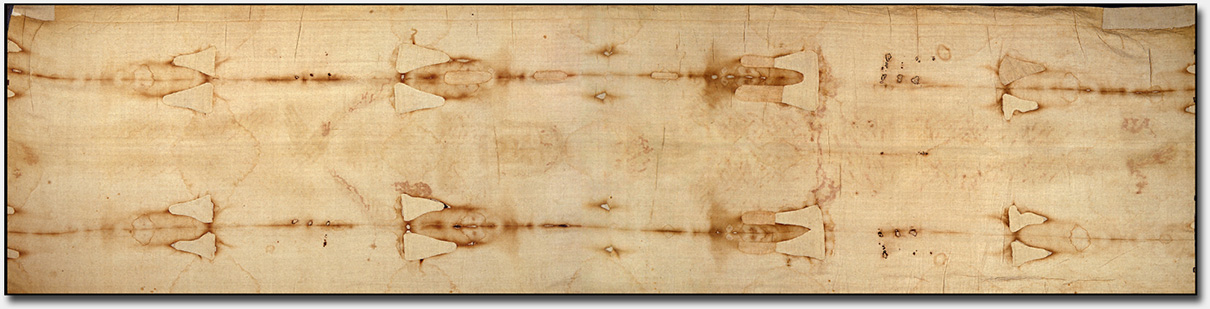
Image: The Shroud of Turin | Source: shroud.com
Why the Shroud of Turin is a Prove of Jesus Resurrection
The Shroud of Turin is the most studied single artifact and one of the most studied religious items of all times. What makes the Shroud very popular and likely the original Biblical shroud is that the image is not showing any trace of paint or dye, rather, it is inscribed on a 0.2 microns of the Shroud fibers with a 3D information that even scientists cannot replicate. The pollen grain, DNA analysis, and other materials found on the Shroud is traced to the Middle East origin.
The blood stain on the Shroud of Turin is blood type AB with high level of creatinine and ferritin, which indicate that the victim whose image appear on the shroud faced trauma and torture before his dead. 3D AI-generated image of the inscription on the shroud shows a Middle Eastern man who was brutally tortured so much that he had about 135 injuries on his body with so much blood. There are signs of lashes, thorn wounds, and a side injury that correspond to the story of Jesus suffering and death on the cross as told in the four Gospels of the New Testament.
There are so many reasons some researchers believe that the Shroud of Turin has a 90% chance of relating to Jesus of Nazareth. In fact, according to recent studies, the linen's structural degradation is fully compatible with a sample dated to 55-74 AD. This conclusion was made by researchers using Wide-Angle X-ray Scattering (WAXS) at the Institute of Crystallography in Italy. This effectively challenges the 1988 radiocarbon dating that traced the Shroud to 10 century AD.
Why the Debate About the Shroud Still Prove Jesus Resurrection
While there is ongoing debate about the origin of the Shroud, countering it does not erase the fact that is almost impossible for any painting or medieval technology to create such a 3D image of a crucified man with wounds consistent with the biblical account of Jesus (scourging, thorns, nail wounds), using a strong laser or a radioactive ray that didn't exist then. Even if the odds is strong enough to counter it, it doesn't change the fact that the story of His crucifixion is a well established agelong fact. The fact that the Shroud of Turin dates back to centuries ago still proves that the story of Jesus' resurrection is a age-long belief.
b. Archaeological Evidences
Many archaeological evidences exist to prove Jesus truly lived, died on the Cross, and resurrected. Some of the most popular of archaeological artifacts to prove this are the Pilate Stone, the Caiaphas Ossuary, and the 1968 crucifixion findings which confirmed the Roman execution methods in the first century to include crucifixion as the cruelest punishment. There have also been discoveries in key locations include the Church of the Holy Sepulchre, the Pool of Bethesda, and the Nazareth House. These artifacts and archaeological discoveries provide clues that can be traced to the gospel stories of Jesus of Nazareth.
Contemporary Evidence of Jesus Life, Death and Resurrection
1. The Gregorian calendar
The most acceptable calendar in the world to this day is the Gregorian calendar which almost everyone knows and uses. Therefore, do not forget that our current calendar points to Jesus. We are in year 2026 AD. AD is an abbreviation that translates Anno Domini, a Latin phrase for "in the year of the Lord". The calendar which is the basis of the Western timing was introduced by Pope Gregory XIII in February 1582 and adopted immediately by many countries. It is considered the most accurate calendar. Whenever you say a year, know that you are saying it in honour of Jesus Christ.
2. The Christian Faith
Christianity is the largest religion in the world. As of 2026, the global Christian population stands at 2.3 billion, making it the most popular religion. Christian do not only have numbers, but they command wealth. Christians control global wealth by holding over 55% of all wealth on earth. This influence is huge in the sense that the only religious group that follows is Islam with just 5.5% of global wealth. Before you understand why this matters, you need to understand what Christianity is all about.
The word "Christian" means "Chris-like". Christianity is therefore a religious group or practice that has to do with living like Christ or adopting a lifestyle that fits his teachings by believing in Him.
What does it mean to believe in Jesus?
Believing in Jesus means to have faith in Jesus by trusting in your heart that Jesus came, died on the Cross, resurrected, and that only Jesus can save. This is shorten in Romans 10:9 which states, "If you confess with your mouth that Jesus is Lord, and believe in your heart that God has raised Him from the dead, you will be saved" (NKJV)
Why the Christian Faith Proves Jesus Death and Resurrection
The pillar of Christianity is the authenticity of Jesus death and resurrection. If the story of Jesus resurrection is false, then the Christian faith has no ground to stand upon. The resurrection is the cornerstone of the Christian faith as stated by Apostle Paul in 1 Corinthians 15:14 (KJV): "And if Christ be not risen, then is our preaching vain, and your faith is also vain."
The above Bible verses and the influence of Christianity shows how influential is the death and resurrection of Jesus Christ and how many people, dead and alive, believe in Him. Not only Christians believe in Jesus, millions who are not even Christians acknowledge the life, death and the story of the resurrection of the historical Jesus.
For one to disprove that Jesus died on the Cross and resurrected will mean destroying the very ground that Christians stand. No one has ever proven otherwise, neither is there any historical or any evidence to prove that Jesus did not die or resurrect.
3. Geographical Locations
The story of Jesus birth, death and resurrection is not a myth like the Epic of Gilgamesh, the Myth of Adapa or stories of the Greek and Egyptian gods. It is a story with real-life dates and geographical locations. The story is told with landmarks that still exist to this day. Jesus was born in Bethlehem and lived in Nazareth of Judea, and taught in Jerusalem, Galilee, and many other places that are still available to this day. The roads Jesus walked on, the places he visited, the River Jordan he Baptized, the Sea of Galilee that he calmed the storm, are all places that one can visit today. And they all match the ancient Biblical story about Jesus without contrast. If those places are real, it means a lot when it comes to proving that Jesus is real.
4. The Life and Faith of the Apostles and Early Christian Believers
Early followers of Jesus were highly persecuted, hunted down, and even killed. All the Apostles of Jesus were killed for their faiths except John the Beloved, who survived several attempts to take his life until he was even exiled to the Island of Patmos where he wrote the Book of Revelation. Not only the closest disciples of Jesus but millions of believers have died afterwards for the sake of the Christian faith. These people, especially the early Apostles, did not just die because they loved death, but they died for what they believed their eyes have witnessed. They believed Jesus rose from the death and were ready to die for that cause. It is very hard for anyone to die for what they know as a lie. The disciples of Jesus all died saying that they saw the resurrected Christ even when they had the chance to denounce such claims an live. This strong faith is another evidence to prove Jesus' death and resurrection.
The Miracle Many Ignore About Jesus' Death and Experience on the Cross
You see? The argument should not be about his existence or crucifixion because it is a confirmed fact. However, while we focus on the cross and the resurrection, and "The Blood of Jesus" phrase sounds so beautiful, an important part is ignored:
Jesus was so badly beaten that his organs ruptured and almost no part of his skin was left unbruised, and his blood almost runs off. A normal human being would die instantly at the point of his beatings. The fact that they had to find someone else to help carry the cross was not out of mercy. He was so beaten that he barely was able to breath, and walking was almost impossible that they had to drag him to the cross. That Jesus even survived to the cross was a miracle that we failed to ignore. No wonder, His endurance to the cross all happened to fulfilled what the prophets said about him and what He prophesied about Himself.
Conclusion
Many evidences exist Jesus truly existed, lived a perfect moral life, taught good morals, did miracles, faced false accusations and trial, suffered and died on the cross, and resurrected. No other man on earth had ever lived the life of Jesus neither have the power that he commands to this day despite not having any political interest or connection. It shows there is something very unique about this Jesus of Nazareth. The Christians believe he is God incarnate, also called the only Begotten Son of God. Jesus referred to himself as Son of God, and claimed to be the one with God The Father. While it is normal to doubt such claims, the fact that Jesus forgave sins, raise the dead to alive, never lied, and did all that was attributed to God makes considering Him as who He said he is a wise decision. It does not matter what you believe but it is worthy to consider knowing Jesus more, perhaps, He is the Way, the Truth and the Life as he said.
To learn fully about the birth, life, teachings, trial, dead, resurrection and the return of Jesus Christ, read the New Testament of the Bible. John Gospel is the forth book of the New testament but it can be a good start as focuses more on the true identity of Jesus.

Abas Obot
Abasiama Akpan (pen name: Abas Obot) is a creative writer who aims to inspire, inform and educate his audience. His major focus is on human capital development, forged by his educational background, passion, experience, and personal objectives. Interested in writing, coding, music, and STEM. Co-founder: Inspired Scoop. Social handles @Abasdgreat , facebook twitter instagram linkedin email